
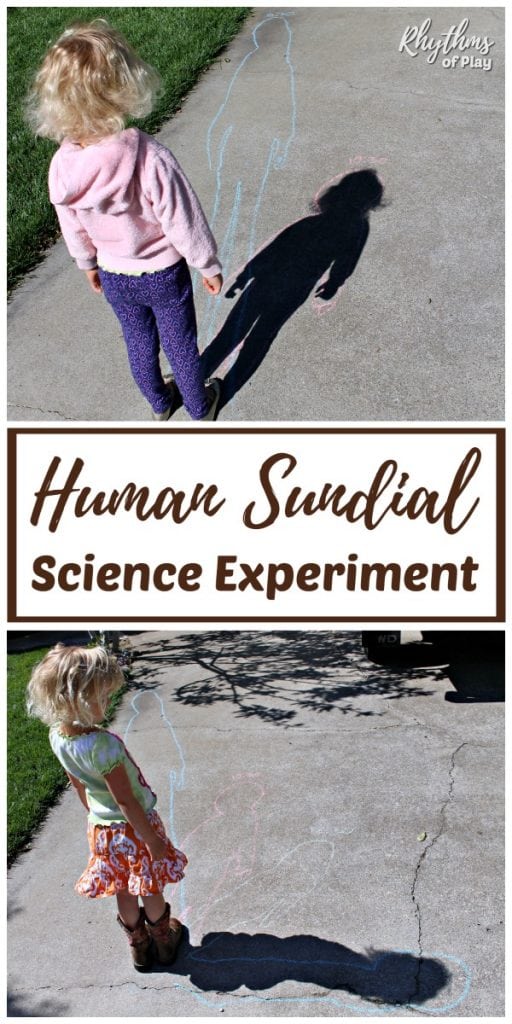
Hands-on outdoor science activities, such as this human sundial experiment, can help children learn how shadows are created and measure the Earth’s rotation.
Make a sun clock with this outdoor science experiment and activity for kids using a human sundial. Help children learn about shadows, sunlight, and the Earth’s rotation. Most children think that the sun moves across the sky throughout the day. Outdoor shadow activities, such as making a human sundial, can teach kids that the sun isn’t moving; instead, they learn that the Earth is spinning! It is a fun and educational solar science activity for kids of all ages. You might also enjoy five ways to have fun with shadows.
Children in elementary, middle, and even high school can understand basic science concepts while conducting a human sundial outdoor shadow science experiment. I will never forget the fun shadow activities I did with my classmates in elementary school. I stayed late that day to admire the beautiful shadow tracings of our human sundials all over the playground while trying to make sense of it all. That’s the power of hands-on learning activities, like this human sundial shadow experiment for kids. First published on May 7, 2016, this science experiment tutorial is regularly updated to enhance the content. You may also enjoy this STEAM art project, which features shadow art.
Related: Rock Balancing Stone Stacking Art
What is a sundial or Sunclock?
A sundial is a fascinating ancient timekeeping device that uses the sun’s movement across the sky to tell the time of day. It is one of the oldest known instruments used for keeping time. As the day progresses, the sun moves across the sky, causing the object’s shadow to shift and indicate the passage of time.
It is well-documented that ancient Egyptians widely used sundials. They were also employed in France and by the Greeks and Romans before the development of mechanical clocks. Over the centuries, sundials have been designed in various forms since ancient times, and today, several types of sundials exist.
The general design of a sundial includes a flat plate or a concave surface marked with hour lines and a gnomon, a slender rod or triangular piece positioned at the center. As the sun’s rays strike the base plate of a sundial, the gnomon’s shadow moves along the marked hour lines on its surface, and the tip of the shadow indicates the time. Thus, sundials offer a reliable and straightforward method for determining the time of day, eliminating the need for complex machinery or batteries.
What is the needle on a sundial called?
The central stick or needle of a sundial is called a gnomon. In a human sundial, the person standing upright in the middle acts as the gnomon, casting a shadow upon the ground as they block the sunlight.
What is a human sundial?
A human sundial, also known as an analemmatic sundial, utilizes a person as a vertical shadow-casting object to indicate the time by noting where the shadow crosses hour lines on an elliptical dial. In other words, the upright standing person is the gnomon or pointer at the center of the circle that casts a shadow that falls onto the flat surface of the sundial to determine the time of day.
If you plan to use the sundial to accurately tell the time of day throughout the seasons of the solar year, use a GPS or another device to determine latitude and mark the sundial’s central plinth with the months so that each month, a person stands in a slightly different spot within the center of the circle.
Human Sundial Solar Science Shadow Experiment for Kids:
Imagine the magic of transforming your children into living, breathing sundials—this is precisely what a human sundial is! Use this solar science activity as an engaging and interactive way to experience the passage of time throughout the day, utilizing the sun as the light source and an individual’s upright standing body as the gnomon or needle of a sundial.
The human sundial offers a beautiful opportunity for children and adults of all ages to understand the sun’s movement and relationship with time, bridging the gap between ancient knowledge and modern-day curiosity.
Conducting these solar science experiments is a captivating blend of science, history, and fun, making it a perfect educational activity for kids and adults of all ages. Invite children to step into the spotlight of the sun and allow their human sundial to unlock the ancient mysteries of the earth’s rotation and the passage of time right before their eyes with the easy instructions below!
Shadow Science Experiments for Kids: Make a Human Sundial or Sunclock
Making a human sundial is one of my favorite childhood science experiments. I remember making human sundials for the first time with my classmates in elementary school. We marched out to the playground together to trace our shadows in the sunlight and record our observations in our science notebooks several times that day.
Everyone was assigned a partner, and we designated one person as the tracer and the other as the tracee. We worked in pairs to record our observations and answer our teacher’s questions. (Other fun outdoor learning ideas can be found in Birding for Kids.)
We had so much fun that I will never forget that day or what I learned from it. I was so excited to share it with my daughter that I decided to try it with her one day. She was a bit young the first time we made a human sundial together, but she loved it!
How do you make a human sundial?
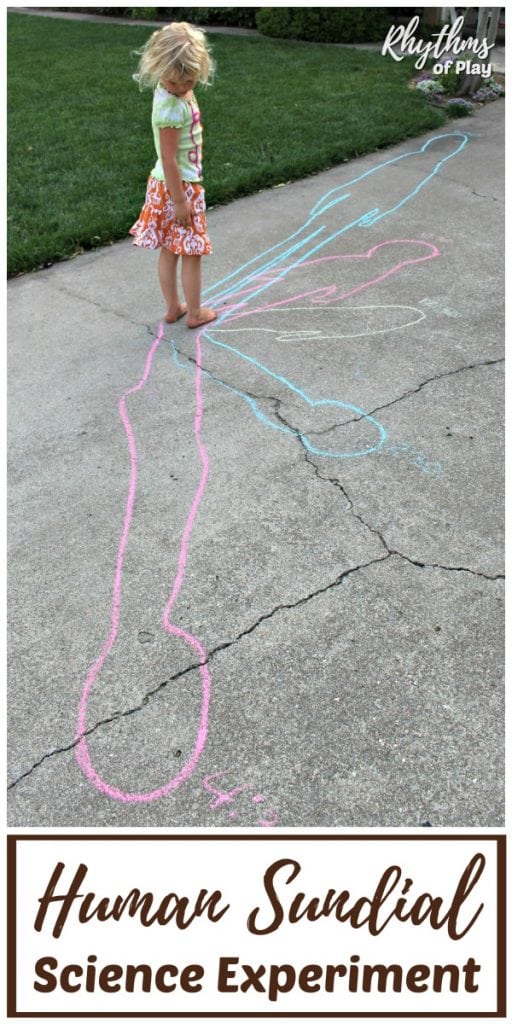
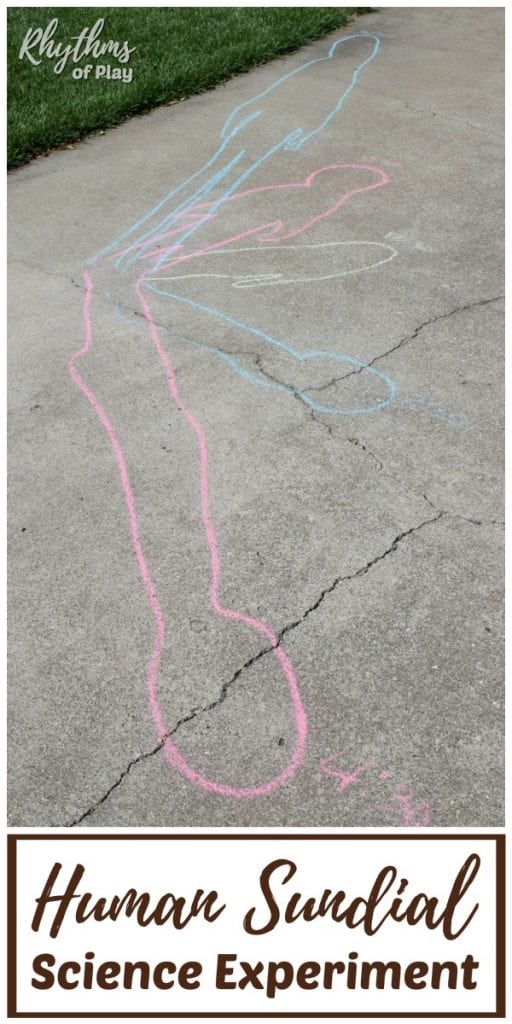
Please scroll down for a step-by-step tutorial on making a human sundial. It describes how to make a human sundial similar to the one with my daughter standing as the gnomon (the needle of the sundial) in the photograph below. Directly below the photo are the directions for the solar science experiment.
After the instructions for the sundial science experiment, you will find human sunclock adaptations you can try at home or in the classroom to increase understanding and build on the concepts learned. These include step-by-step instructions for making a human sundial that accurately tells time. Please read the instructions and gather the recommended supplies before beginning your experiments and creating human sundials. Kids also enjoy magnet fishing science!
Related: Shadow Art Outdoor Science
Outdoor Shadow Science Experiments Supplies
- Full sun: Safe outdoor area.
- Look for an open space with no shadows and a clear sky overhead.
- Driveways, parking lots, and playgrounds work well.
- Sidewalk chalk (or DIY chalk paint).
- Camera for pictures (optional).
- Tape measure (optional).
- Science notebook or nature journal and a pen or pencil to record human sundail observations (optional).
Human Sundial Shadow Science Experiments: Recommended Reading for Kids
Help children learn more about shadows and how they are formed. The children’s books below can help kids learn about the sun and the Earth’s rotation and movement through our solar system. Choose at least one or an alternative for kids to read as an adjunct to this science lesson.
- What Makes a Shadow
- Next Time You See a Sunset
- Tell Me Why There Is Day and Night
- Light is All Around Us
Related: Rainbow Science for Kids
Human Sundial Shadow Experiment Step-by-Step Instructions:
Read through the easy step-by-step instructions below to learn how to conduct a human sundial science experiment before getting started, so you understand the steps involved in this hands-on science activity for kids and know what to expect. If you want to create a human sundial that can tell time accurately, skip to the next section to see directions to make a sundial that tells time.
1. Conduct your human sundial science experiments on a sunny day when no clouds, rain, or snow is expected:
- It must be sunny to trace shadows all day, so do your best to conduct this sundial experiment on a bright, cloudless day.
- Unfortunately, if clouds move in during the day, you must scrap your human sundial shadow science experiments for another day.
2. Find an open area at school or near your home where the sun’s light shines all day to make a human sundial:
- Find a wide, open spot that receives full sun all day. Playgrounds, driveways, large parking lots, the top level of a parking structure, rooftop patios, and large open pool decks usually work well.
- Ensure you have sufficient space in all directions around you. Shadows of trees, poles, cars, and everything else can grow long, and houses often cover driveways (like ours did).
- If there are trees or structures near the area you are considering, check the location at sunrise, midday, and evening to ensure it is not shadowed at any time.
- You need the sun on this sundial to trace the human gnomon’s shadow!
- Remind yourself that shadows move and change throughout the year, so a spot that works in winter may not work in summer, and vice versa.
- If you conduct this sundial experiment with a class, divide them into small groups (or pairs) and ensure the children are spaced far enough apart to create their human sundials. You will need approximately 10-20 feet of space between each group or pair of students.
- Another option is to make one sundial with the whole class. If you choose this option, trace the same person throughout the day to control for height and size differences.
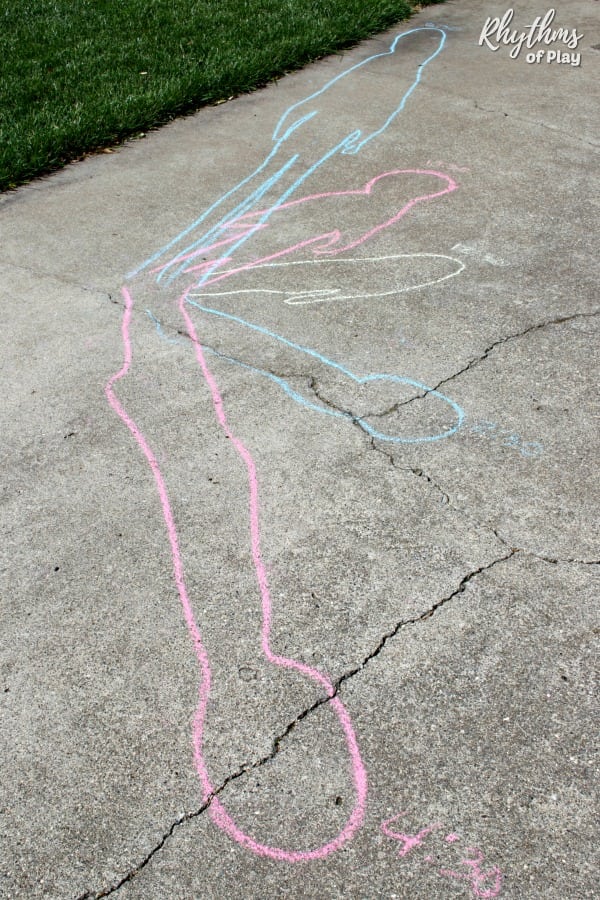
3. Place an ‘X’ on the spot where the person will stand each time they have the outline of their shadow traced:
- Place an ‘X’ where you want your child to stand to act as the needle or gnomon of the compass.
- Or find another way to mark the spot where the child will stand for each shadow portrait measurement.
- The idea is to find a way to create a center mark for the spot where the human gnomon will stand in a way that will last all day and not move.
4. Use sidewalk chalk to trace the shadow’s outline:
- Trace the human gnomon’s shadow with sidewalk chalk or DIY chalk paint.
- To perform this solar science experiment effectively, it’s best to trace one person’s shadow outline at least three times.
- If you are working with a class, split them up into smaller groups and have them trace each other’s shadows.
- Morning, midday (solar noon, when the sun is at its highest point in the sky), late afternoon, and/or early evening are great times of day to trace shadows for these outdoor science experiments.
- Think of mealtimes as your cue to trace the shape of the shadow. Or set an alarm to remind you to go back outside to trace the shadow’s outline a few more times throughout the day.
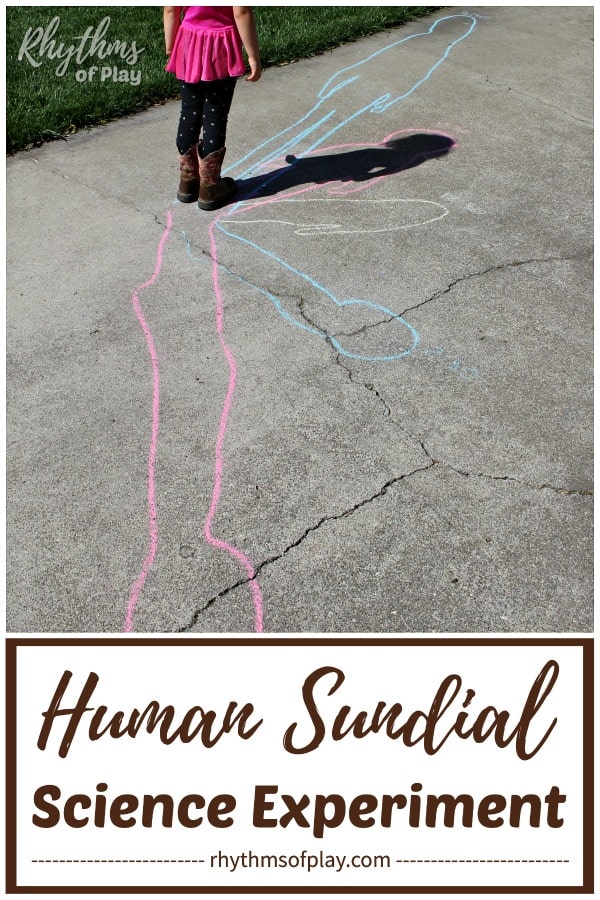
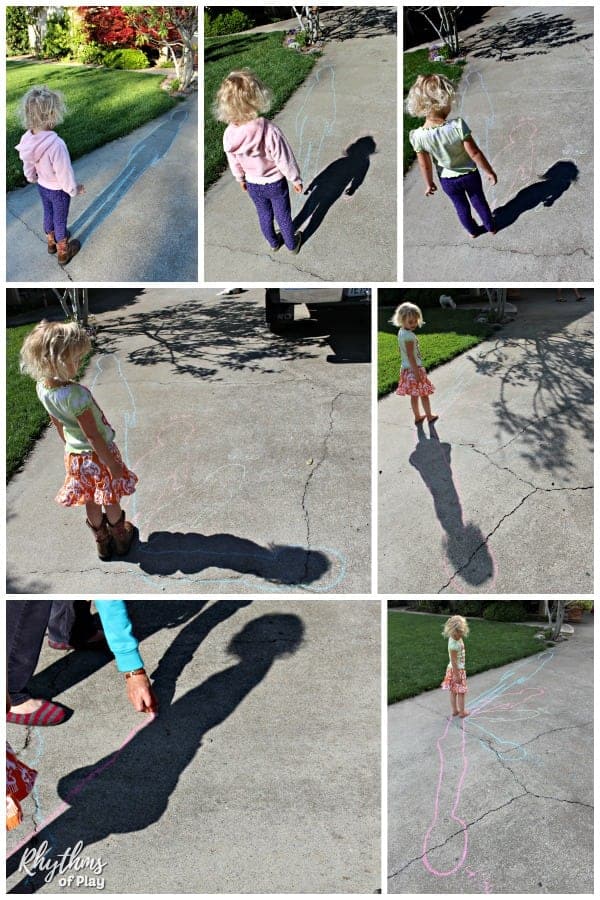
- My daughter and I traced the outline of the shadow and photographed the changing sundial every two hours, as shown in this post.
- To do so, we conducted our human sundial shadow experiment at 8:30 a.m. and took tracings at 10:30 a.m., 12:30 p.m., 2:30 p.m., and 4:30 p.m. in the spring of 2016 in Northern California.
Optional steps to complete each time you trace a shadow for the sundial:
- Use sidewalk chalk to note the time of day next to each shadow tracing.
- Invite children to describe the shape and size of the shadow each time they make a recording. (long and skinny, short and fat, etc.)
- Take photos and record all other observations in a scientific notebook or homemade nature journal. (optional)
- Ask children to note the sun’s position in the sky.
- In other words, have them point out the general location of the sun when they make each tracing.
- Please measure the length of your child’s shadow each time you trace it and record it in your notebook.
- Ask your children to predict where their shadow will be and what it will look like at the next tracing time.
- For even more fun, paint each shadow or around the human sundial with DIY chalk paint.
5. Invite children to compare Shadow Experiment observations and formulate a hypothesis:
- Use this activity to discuss why the shadow changes throughout the day and the remainder of the year.
- Ask your kids the questions or try any adaptations of the human sundial experiment below (in the next section, scroll down) to get them thinking.
- Later, you can explain that our Earth spins on its axis in a day and orbits the sun in a year, producing the changes we see in our shadows.
- But first, allow children to attempt to discover the answers to the questions they seek and try to figure it out on their own.
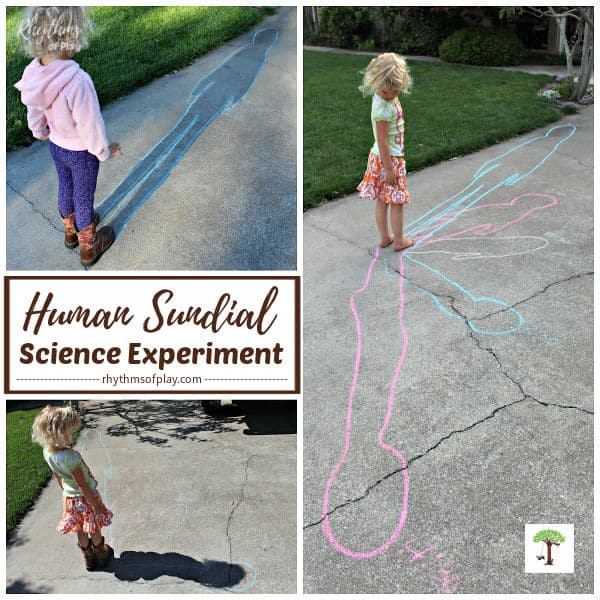
6. (Optional) Fill in sundial shadow outlines with chalk paint:
- Make DIY chalk paint and use it to fill in the shadow outlines you traced throughout the day, creating beautiful shadow art.
- This art activity can extend the experiment and make a beautiful artistic rendering of the shadows traced throughout the day.
Optional Questions to Ask Kids During and After Human Sundial Shadow Experiment:
- How do you think shadows are made?
- What did you observe about your shadow and the sun?
- Did the sun move? If yes, which direction?
- In what direction did your shadow move?
- Are the tracings the same? Why or why not?
- Did the length of the shadow tracings change?
- When was your shadow the longest? When was it the shortest?
- Why do you think that your shadow changes throughout the day?
- Do you feel that your shadow also changes throughout the year?
Related: How to Make and Keep a Nature Journal
Human Sundial Shadow Science Experiment Adaptions:
- To extend this human sundial shadow science activity, try any of the following adaptations:
- Use DIY Chalk Paint to paint your human sundial tracings into a gorgeous work of sidewalk chalk art. Human sundial sidewalk chalk art paintings are lovely!
- Draw a large circle around the sundial drawing (or create a chalk painting) and use a compass to represent the four directions.
- Conduct the human sundial experiment during standard and daylight-saving time and compare results.
- Compare results, such as the length of shadows at each measurement time, with students in another time zone or at different latitudes on Planet Earth.
- If you try this, use the exact height of human gnomons for increased accuracy.
- Or, do this simple solar science experiment on or close to the summer solstice (the longest day of the year), fall equinox, winter solstice (the shortest day), and spring equinox in the exact location each time. Then, record the differences in the human sundials you create.
- Taking photographs and recording your observations in a nature journal or science notebook is an excellent way to track changes throughout the year.
- Use what you learn from conducting this experiment to create a human sundial that accurately tells the time throughout the year’s months.
- To try this, follow the steps below:
How to Make a Human Sundial That Tells Time Accurately:
- Choose a Location: Select an open space where the sun’s path is unobstructed throughout the day, preferably a flat surface like a field or a large yard.
- Determine Latitude: Use a GPS, online maps, or another method to determine your location’s latitude.
- This is crucial for accurately positioning the sundial.
- Position the Person (Gnomon):
- Stand the person (the gnomon) upright on the ground, facing due north (in the northern hemisphere) or due south (in the southern hemisphere).
- Ask the person to extend their arm horizontally, pointing directly toward the celestial pole corresponding to their hemisphere (north for the Northern Hemisphere, south for the Southern Hemisphere).
- Mark Hour Lines:
- Beginning at solar noon (the sun’s highest point in the sky), observe the shadow cast by the person’s body.
- Mark the position of the shadow using acrylic paint and a paintbrush or a paint pen at hourly intervals throughout the day.
- Please ensure the marks are accurate and precise.
- Each mark represents an hour line on the sundial.
- Label Hour Lines:
- Label the hour lines with the appropriate hour numbers, starting from one side (usually east) and going clockwise (in the northern hemisphere) or counterclockwise (in the southern hemisphere) around the sundial.
- Measure and Mark Monthly Standing Location for Human Gnomon:
- Finally, mark a central point for each month of the year for the human gnomon to stand upon.
- You will need to measure and create a mark each month on the correct location in the circle for the human gnomon to stand each month of the year, so that the time markings read accurately for each point of the solar day.
- Finally, mark a central point for each month of the year for the human gnomon to stand upon.
Related: Art and Science: Experiment with Watercolor Resist
Human Sundial Outdoor Science Experiment: Our Process
I had difficulty finding a space in our driveway with full sun all day that would work for our shadow science experiments. Shadows fall over our driveway throughout the day, so I watched the sunlight cast upon it for a few days to find a suitable spot.
In the spring, we did our shadow tracings at 8:30 a.m., 10:30 a.m., 12:30 p.m., 2:30 p.m., and 4:30 p.m. We would have done one last one at 6:30 p.m. if our house had not completely shadowed our driveway and our shadow science experiments at that time.
You can see my daughter standing in her sundial at 6:30 pm in the bottom right photo in the photo collage below. She and our sundial are in the shade because our house began to eclipse the sun.
I love our photographs because they document the changes in my daughter’s shadow throughout a day in Northern California in the spring of 2016. And they also showcase my daughter’s wardrobe changes throughout the day! Those preschoolers are funny, aren’t they?
Related: Sorting and Classifying Rocks
Human Sundial Shadow Experiment for Kids:
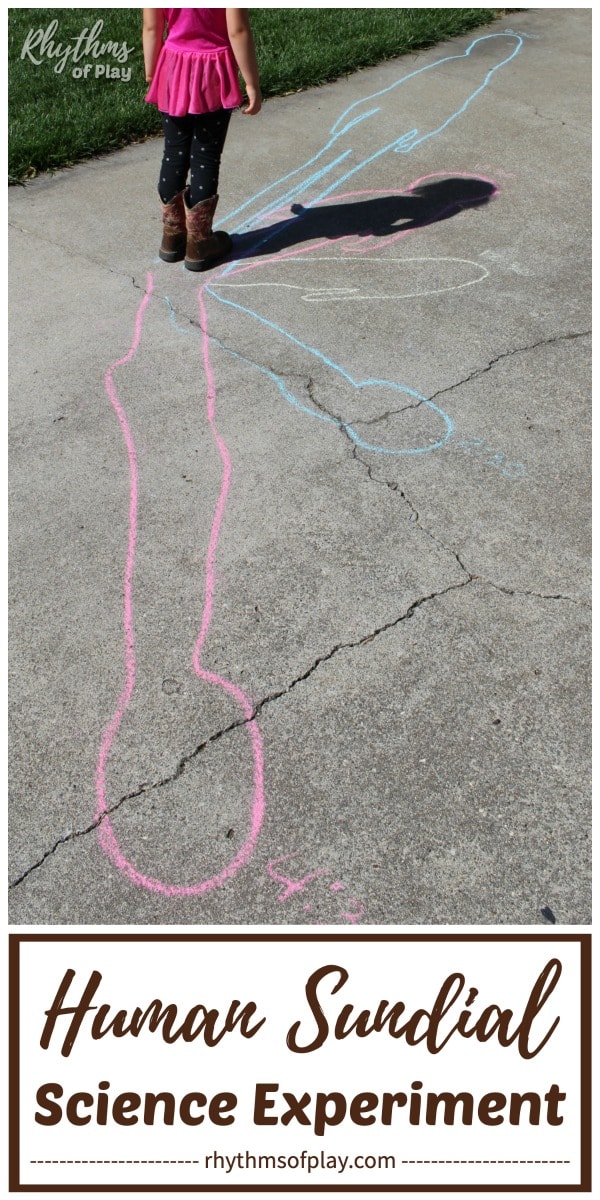
This human sundial shadow science experiment can help your children learn about the Earth’s rotation by tracing shadows throughout the day. Shadow science experiments are easy, hands-on ways for children to learn how shadows form and are also fun ways to measure the Earth’s rotation.
When we tried this for the first time, my daughter was only three years old. She was too young to complete tasks like recording her observations in a science notebook, so I asked her questions and wrote down her responses. The questions I asked dovetailed with her responses and led her to conclude that we (planet Earth) are rotating to produce the changes in our shadows throughout the day.
Since that day, we have continued to discuss how the Earth rotates to create day and night. I have also begun teaching her how to tell time and what that means in terms of the Earth’s movement and the sun’s position.
More Outdoor Science Activities
If you are looking for more outdoor science activities, consider trying shadow art, rock balancing, skipping stones, or rainbow rainy day art!
And if you have a budding naturalist at home, you might want to check out our top 10 Nature Study Supplies.
For more ways to have fun with shadows, click on the link.
Learn more about Nell Regan Kartychok, author, photographer, and creator of this original human sundial shadow experiment HERE, and Rhythms of Play HERE!
More Science Ideas for Kids:
- Sorting and Classifying Rocks: Geology for Kids
- Rainbow Rainy Day Art: STEAM Activity
- Art & Science: Experiment with Watercolor Resist
- Fishing with Magnets: Cool Science for Kids
- Get Outside and Connect
- Birding for Kids: Bird-Watching Lessons and Activities
- How to Skip Rocks: The Art and Science of Skipping Stones





Leave a Comment